
How Big Should a Village Be?
Dear Friend,
After my last post about my dream of creating a village, I wanted to expound on one very important detail:
How big would this village actually be?
This turns out to be a surprisingly difficult question to answer. My first instinct is to say, “Not too big!” But how big is too big?
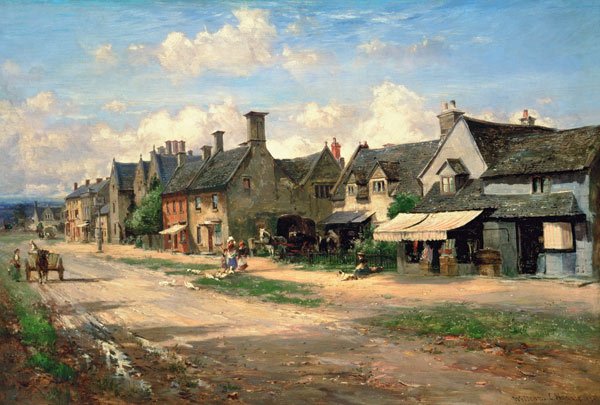
The High Street, Broadway, Worcestershire by William E. Harris (undated)
I have a vague feeling that a village should be small enough that you can walk across it without getting in a car, large enough that there is always something happening, and small enough that you can still run into people you know. And that last part is probably the most important … but I don't want to create a development that just puts houses next to each other. I want to create a place that encourages connections, lots of little “collisions” that start weaving people’s lives together. I’ve been thinking about how to do that for a while now.
How many people can we actually know?
There's a fascinating idea called Dunbar's number, named after the anthropologist Robin Dunbar, who proposed that humans can maintain roughly 150 meaningful social relationships, which suggests that we don't have an unlimited capacity for relationships.
Think about the difference between a town where you recognize a few faces and a neighborhood where you really know the people who live around you.
I didn’t grow up in a small town, but I imagine that there was a kind of social fabric that seemed to exist almost automatically. You knew who people were. Your parents knew their parents. You knew which houses had children your age. You knew the people at the grocery store and the post office. Nobody had to organize a “community-building event.” The community was simply there. That's what I'm after.
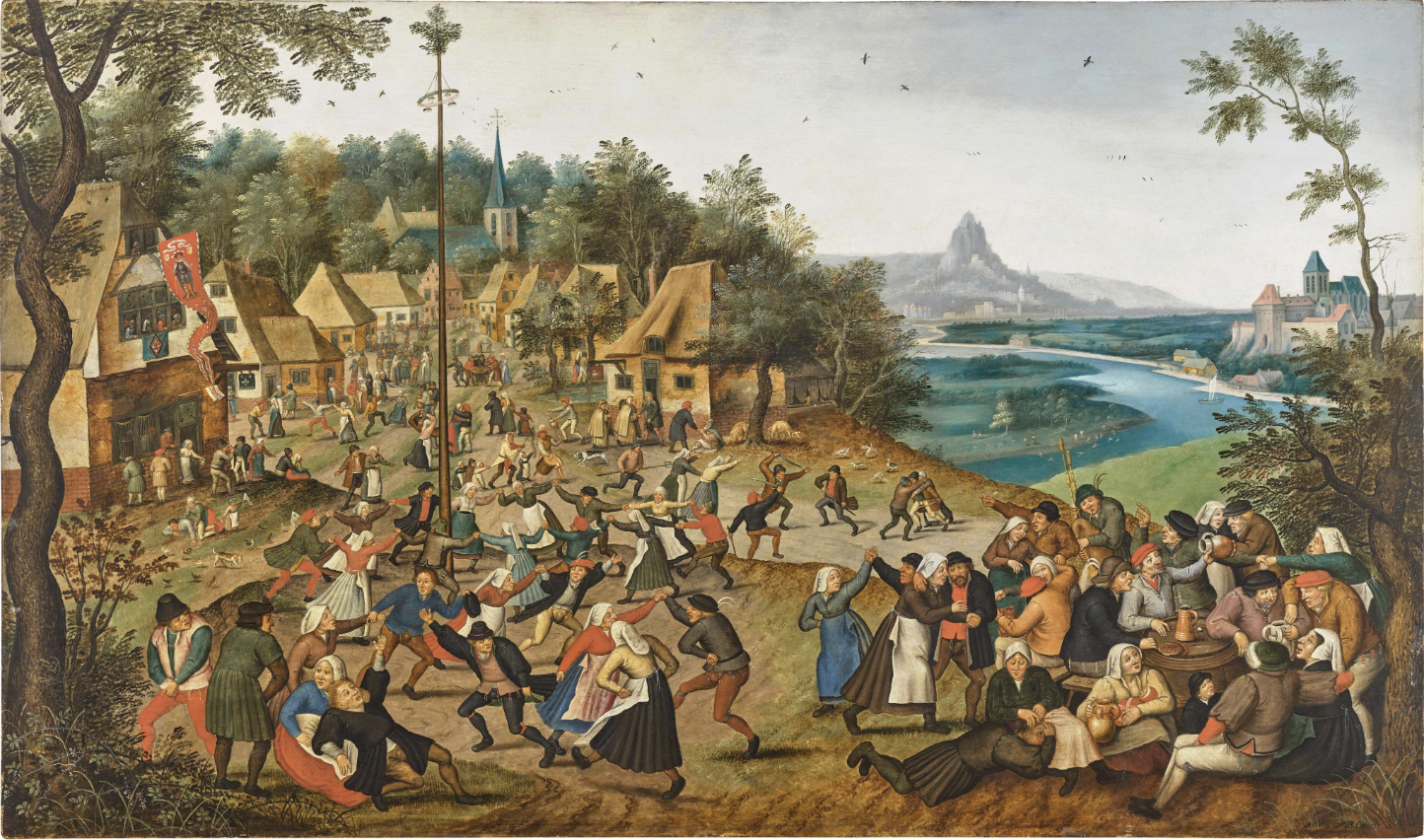
Village scene with peasants by Pieter Brueghel the Younger (early 17th c.)
But I don't want a tiny village, either.
Here's the problem: If there are only 20 or 30 houses, you can have a wonderful little neighborhood, but it becomes difficult to support many of the things I imagine when I picture a village. A coffee shop, for example, needs enough people to actually buy coffee. So does a little store. And a workshop. And a dining hall. And a school. I don't want these things to be amenities that exist because a developer checked a box on a marketing brochure. I want them to be used.
I'd love to have a little village green where there is almost always someone sitting on a bench or children running around. I'd love a coffee shop where you might actually bump into three people you know. I'd love a workshop where someone is always making something. I'd love a dining hall where families regularly meet to have a night off from cooking dinner and cleaning the kitchen and where the relationships can be the focus. For that, you need enough people.
So I started looking at some numbers.
Christopher Alexander's A Pattern Language has long been influential in my thinking about how places work. One of its ideas is that neighborhoods begin to break into smaller social groups once they get much larger than roughly 700 people. Leon Krier, the architect and urban planner, has argued for something even more intimate: that the things you need for daily life should ideally be within about a ten-minute walk. And then there are the Amish church districts, which are generally small enough that everyone really does know everyone else. A district might include somewhere around 30–40 families.
None of these numbers is a magic formula. But taken together, they point toward something that feels right to me:
A village should be small enough to be a community, but large enough to support a real village life.
So I've landed, at least for now, on something like 100–150 homes.
Perhaps 300–500 people. That sounds like a lot when you say “500 people.” But when you picture it as 100 or so houses, it starts to feel quite different. You could divide those homes into several little hamlets, each with perhaps 25–50 houses. You might know most of the people in your hamlet. You'd recognize almost everyone in the village.
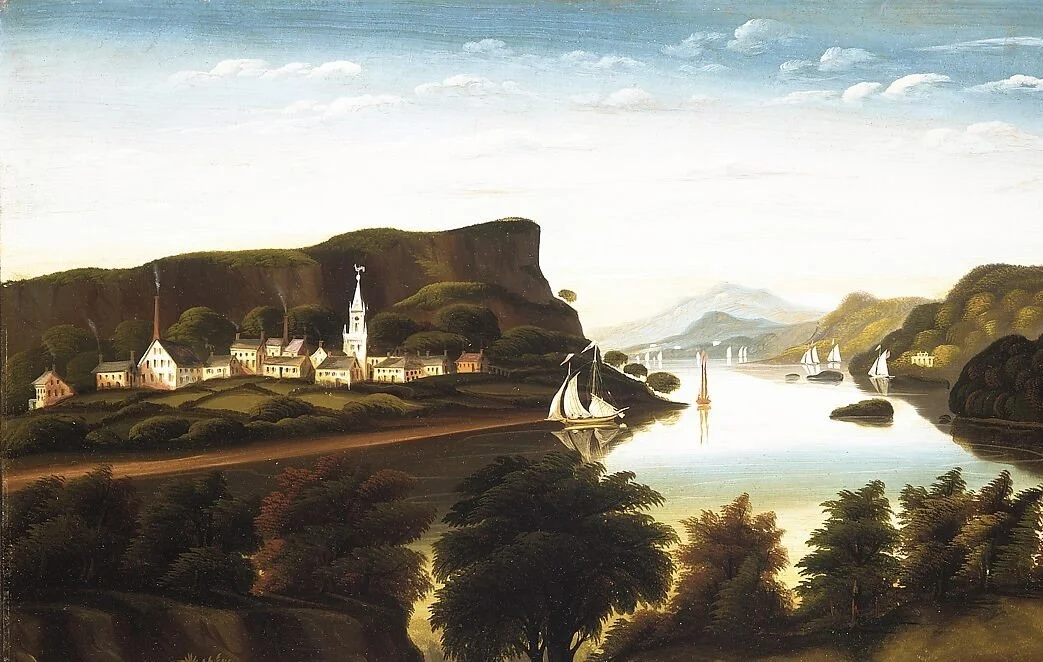
Lake George and the Village of Caldwell by Thomas Chambers (ca. 1850s)
And then there is the land.
This is where my dream starts to look a little different from a typical housing development. I don't imagine 150 houses on 50 acres, with ½ acre each (plus roads, etc.). I imagine 100 houses within a much larger landscape. Perhaps 15-25 acres of homes - 8-12 little hamlets of 8-12 houses each - arranged in compact little clusters around greens and paths. Another 8–10 acres for the village center, with school, chapel, common spaces. And then 150–300 acres of woods, fields, meadows, orchards, and farmland surrounding everything.
The houses themselves could be relatively close together. But the village would not feel crowded. You could walk out your front door and be in the middle of village life—or walk in the other direction and be alone in the woods.
I don't want suburban isolation, where every family has its own little kingdom and you have to get in a car to see anyone. But I also don't want urban density, where the only nature you see is the tree planted in the sidewalk. I want the middle. Close neighbors and open land. Privacy and community. Children who can wander freely, always in sight of someone, but also plenty of places where you can feel like you’re alone in nature.
Which brings me back to the ten-minute walk.
One of the things I love about old villages is that they weren't designed around the assumption that everyone would get into a car every time they left the house (because cars hadn’t been invented yet!). The bakery was down the street. The church was around the corner. The school was a short walk away. The fields began at the edge of town. You could walk to almost everything you needed. And because you were walking, you saw people. You stopped to talk. Your children stopped to talk. You noticed who was working in the garden and who had a new puppy and who needed a hand carrying something.
Those little encounters are easy to dismiss as insignificant. But they are actually some of the building blocks of community. You can't schedule them. You can't manufacture them automatically with a clubhouse and a pool. You have to create the conditions for them to happen naturally.
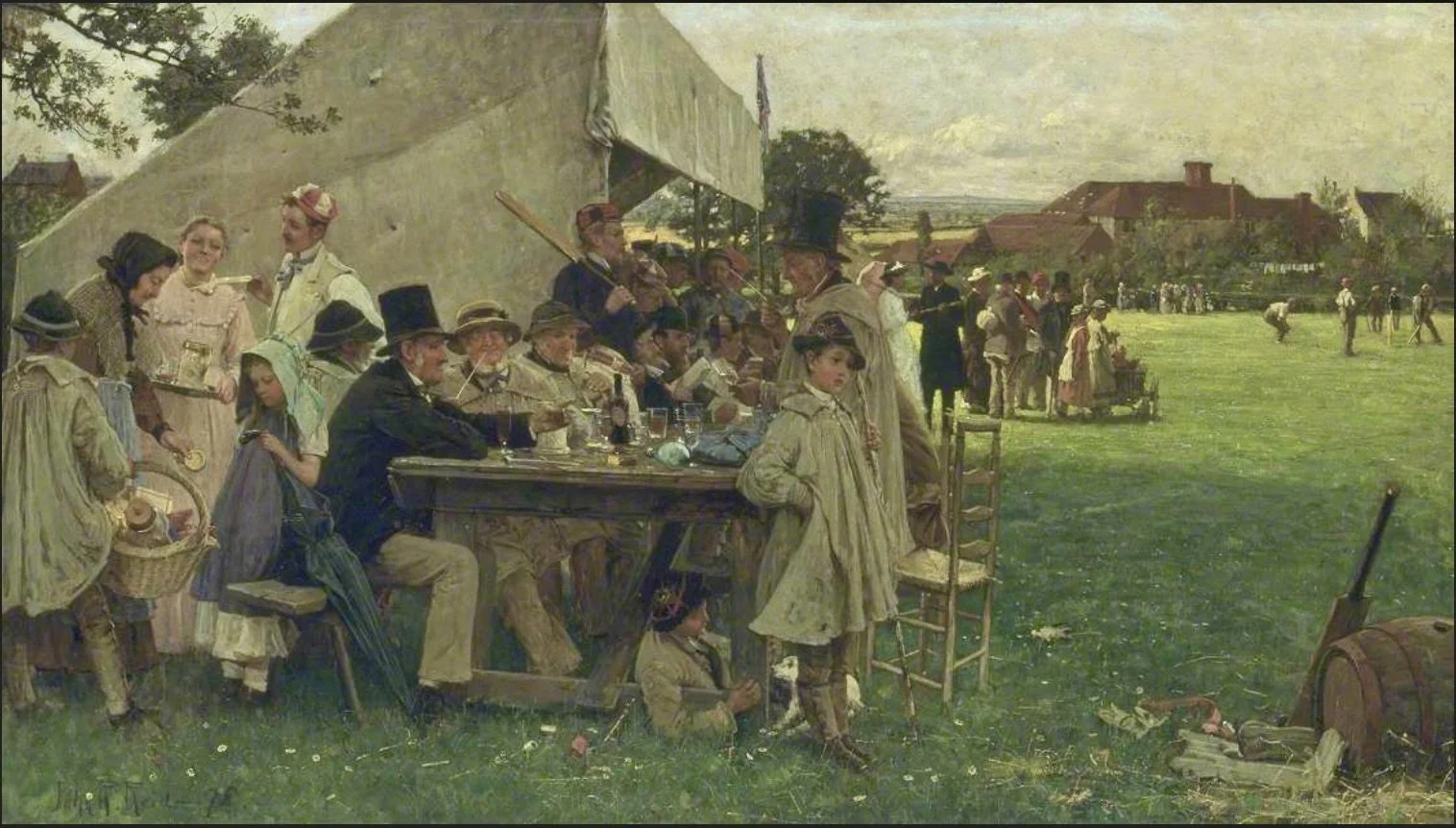
A Country Cricket Match by John Robertson Reid (1878)
The more I think about this village, the more I realize that I'm not actually trying to figure out how many houses we can fit on a piece of land. I'm trying to figure out the smallest scale at which we can create the richness of a real little town. The maximum number of people who can still feel like neighbors.
That's the place I'm dreaming about. And when I get to build it, I hope you'll come visit!
Until next time,
xo Elisa
P.S. Have you lived somewhere that felt like the perfect size? Or somewhere that became too big or too small? I'd love to hear about it.
P.P.S. I hope your summer was great! The highlight of our summer was getting to have the 8 of us altogether for the first time in over a year (to you parents of adults, I know you can relate!) - and it was just for a few days before the oldest kids scattered again. It makes me thankful for the little moments!
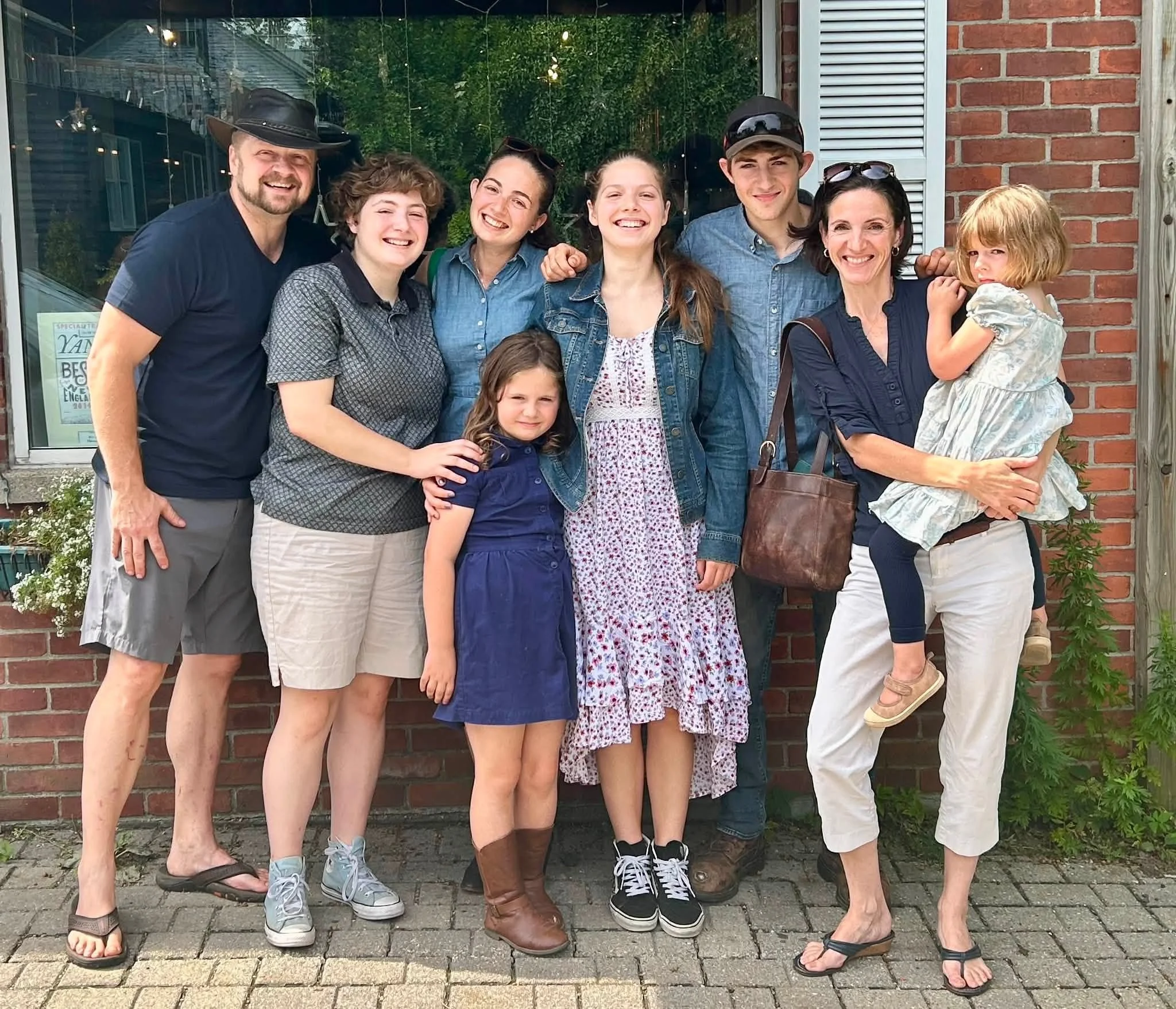
Cherishing our rare time altogether